
Federal Data
Excellence Program
Defining and celebrating exceptional federal data practices
Federal data offers us insight into nearly every aspect of our society, from the strength of the job market and economy to the health care needs of veterans and the impacts of natural disasters. This data has been a cornerstone of modern and effective government, and now more than ever it is critical for agencies to ensure it remains available to public. Making this data widely available empowers leaders to make better decisions, enables more agency accountability and, ultimately, improves the public’s trust in government.
The Federal Data Excellence Awards program is a collaboration between USAFacts—whose mission is to provide facts about the U.S. that are rooted in data—and the Partnership for Public Service. The awards celebrate agencies’ efforts to improve federal data practices and spotlight the transformative power of accessible, transparent government data.
In 2024, the program’s inaugural year, the Partnership and USAFacts developed criteria for assessing federal data products, incorporating insights from federal data leaders. We held discussions with data scientists, evaluators and program officers from agencies across government, including the departments of Education, Health and Human Services, and Homeland Security; the Census Bureau; the Office of Management and Budget, and the National Science Foundation.
Through these activities, we built a community of practice, learned about challenges in the federal open-data landscape and refined our assessment tool, which became the basis for choosing the Federal Data Excellence Awards winners.
Our Partner

USAFacts is a not-for-profit, nonpartisan civic organization that makes government data easy for the public to access and understand. Employing a team of researchers, analysts, statisticians and communications professionals, the organization gathers, examines and synthesizes data on U.S. spending, revenue, demographics and policy outcomes to help ground public debate in facts. Visit USAFacts where you can download the complete set of Federal Data Excellence standards and a quick reference guide, as well as learn more about how the program came to be.
2024 Winners
Financial Product Award
Honors products that share data on federal spending or other financial information. Twenty-five products were assessed in 2024.
Foreign Assistance Dashboard
Department of State and U.S. Agency for International Development
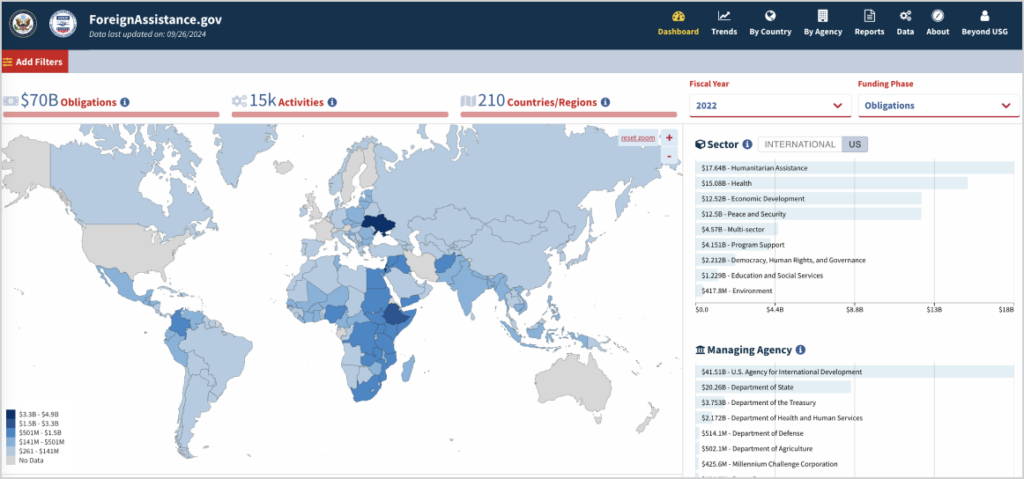
ForeignAssistance.gov is the government’s flagship product for making U.S. foreign assistance data available to the public. Through an interactive dashboard and data visualizations, ForeignAssistance.gov reveals the scale, targeted sectors, and agencies managing U.S. aid programs that aim to foster global development, support humanitarian efforts and advance U.S. foreign policy objectives. Regardless of changes in the scope of foreign assistance, this tool has offered important insights to government leaders and the public about how those aid dollars are deployed.
Compared with the other financial products assessed in 2024, ForeignAssistance.gov offers a wider range of accessibility and interoperability features, making it stand apart from other federal data products that provide financial data.
With an intuitive user experience, plain language, easily accessible documentation, well-structured data and varied bulk data download options, the State Department and U.S. Agency for International Development have created an excellent data product for researchers, policymakers and the public to understand and evaluate one of the primary aspects of U.S. foreign policy.
Administrative Product Award
Honors products that share data collected through agency programs or the delivery of public services and are unrelated to federal finances or spending. Twelve products were assessed in 2024.
Federal Employee Viewpoint Survey Dashboard
Office of Personnel Management
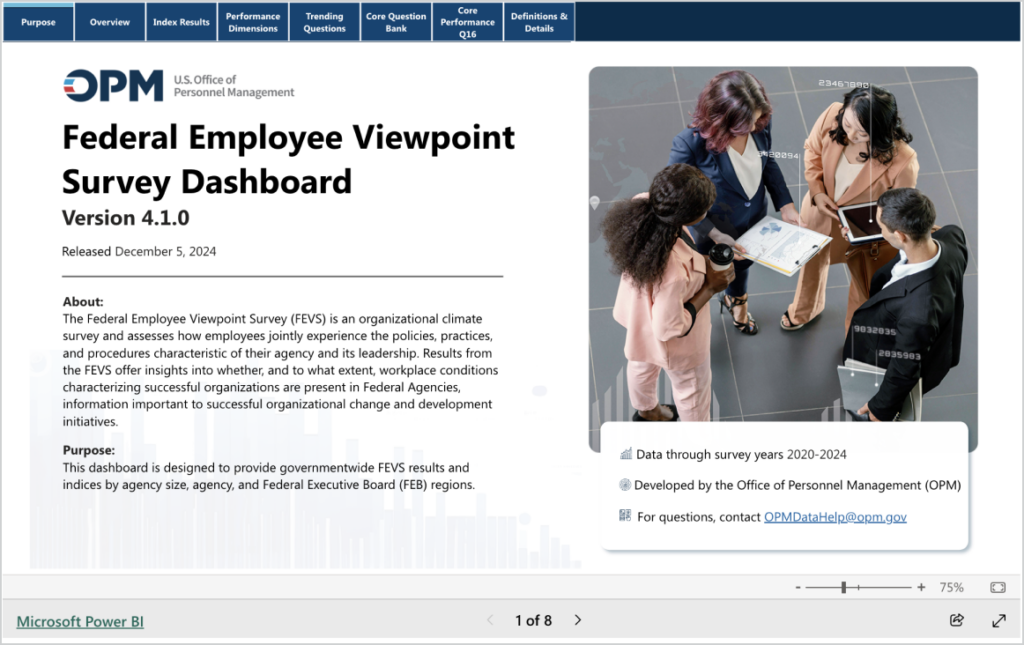
The Federal Employee Viewpoint Survey measures civil servants’ perceptions of the policies, practices and procedures of their agency and its leadership. Agency leaders and policymakers use this data to build better workplace cultures, improve the federal employee experience and enhance organizational performance. OPM created the FEVS Dashboard to provide federal officials and the public with government-wide results and index scores by agency size, agency and Federal Executive Board region. [Note: The Partnership for Public Service relies on the annual Office of Personnel Management survey data to produce its Best Places to Work in the Federal Government® rankings.
Unlike other administrative products, the FEVS Dashboard provides several details to help users understand the niche data the government collects, and its intended use and audience. As an intuitive product with well-structured data that can be linked to other federal datasets, the FEVS Dashboard is a powerful tool for exploring the latest federal employee experience and government performance trends.
Statistical Product Award
Honors products that share data collected through surveys, scientific studies or other research methods. Eighteen products were assessed in 2024.
National Survey on Drug Use and Health State Estimates Dashboard
Substance Abuse and Mental Health Services Administration
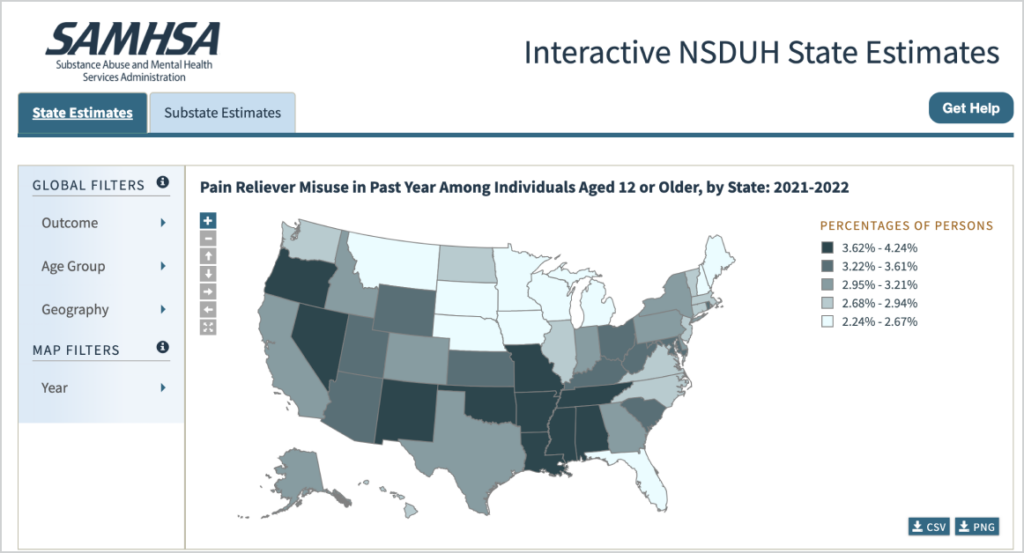
This dashboard provides estimates of substance use and mental health needs at the state and substate levels to enable public and private sector leaders to address unmet health care needs in communities across the country. One example is its Substance Abuse Estimates by State tool through which SAMHSA makes state-specific data on substance use and mental health conditions easily accessible to state policymakers and the public.
With its streamlined user experience and ample documentation, this dashboard’s data is an invaluable resource for government leaders, public health officials and researchers working to address the nation’s ongoing mental health and substance abuse crises.
Honorable Mention: Static Product
Recognizes exceptional products that do not have an interactive component such as a dashboard or data explorer.
Higher Education Research and Development Survey Data Tables
National Science Foundation
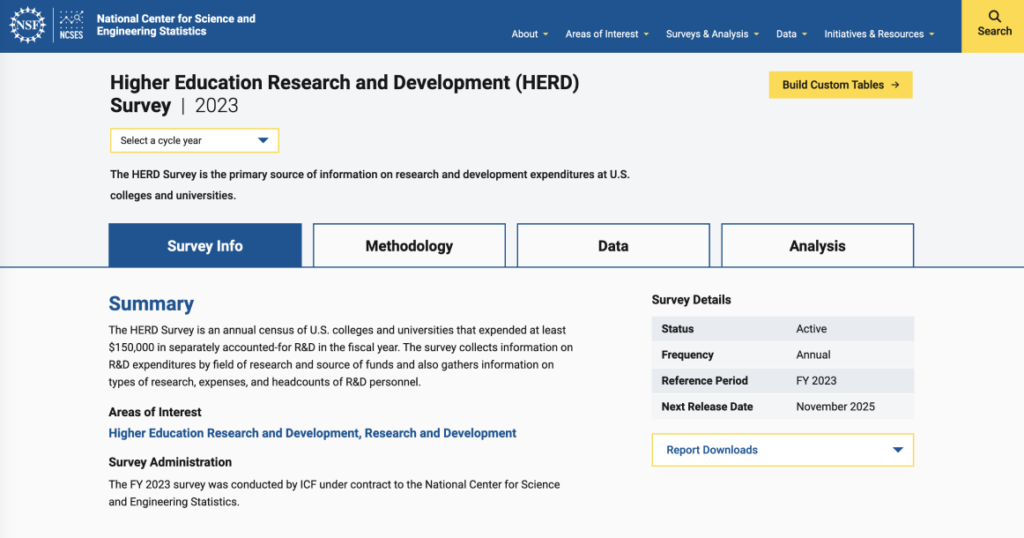
The Higher Education Research and Development survey tracks U.S. higher education institutions’ annual expenditures on research and development. This data is crucial for evaluating trends in academic R&D funding, supporting policy decisions, and analyzing the role of universities in innovation and economic growth.
While it does not feature an interactive component, the survey’s data tables make data easily accessible through well-organized pages and documentation that helps viewers use and interpret the information they need.
How Winners Were Selected
We considered 55 data products for the 2024 awards, using a rigorous evaluation process to select the winner in each category. For this inaugural year, we analyzed the topics and characteristics of the nominated products to create meaningful award categories that covered a wide range of products and had enough entries to make them competitive.
Please see our methodology for more information on how we created the assessment rubric and judged products.
Common Areas for Improvement
and Recommendations
Federal data products make our government more transparent to the public and help political and career leaders make informed decisions. However, we identified several areas for improvement as we assessed products for the Federal Data Excellence Awards. We believe that by addressing these issues agencies will make federal data products more accessible, timely, helpful and interoperable for users. As the Trump administration aims to make our government more efficient and accountable, prioritizing these recommendations will be essential to fostering a modern, accountable government that better serves the public.

Explaining Data Uncertainty
Every data product has limitations, uncertainty and methodological decisions that need to be explained to users. Without clear descriptions of data collection methods and limitations, as well as knowledge about the potential pitfalls with longitudinal comparisons or statistical measures of uncertainty such as confidence intervals, users may misinterpret or misuse data. To address this issue, data products should include well-defined limitation sections, like those the Government Accountability Office uses in its typical report structure. These sections should outline what users can and cannot infer from the data, enhancing their trust in the information provided.

Improving Bulk Data Access
More than 70% of the data products assessed lacked an option to access the full dataset through an Application Programming Interface (API) or File Transfer Protocol (FTP) site, which help technical and nontechnical users easily extract large quantities of data. In some cases, agencies had APIs that provided access to the data presented in the assessed product but did not clearly signal the API’s existence or how to access it, creating a missed opportunity to help users.
Agencies that do not already have one should explore developing robust APIs or FTP sites and clearly indicate their availability on the interfaces of their data products to make the data more accessible. Comprehensive API documentation should go along these tools to streamline data interpretation and integration with other datasets. Products such as Data.Census.gov or USAspending.gov serve as strong examples of how to effectively implement APIs and expand access and utility for users.

Centralizing Supporting Materials
Federal data products often scatter supporting materials, such as documentation and codebooks, across multiple locations. This tendency can overwhelm users, making it difficult for them to quickly understand both the purpose of a product and the data it is built on. Placing resources in a single, well-organized and well-labeled repository simplifies the user experience.
Agencies should also provide plain-language explanations of the related federal program’s purpose and the data’s origins and scope. This approach would not only ensure compliance with statutory requirements, such as the Plain Language Act, but also significantly improve the user experience by making the data’s context and scope clear.
The Bureau of Justice Statistics employed these practices in its Prisoner Statistical Tables.

Publishing More Timely Data
Many products had a significant lag between data collection and publication. Others lacked documentation explaining when the data was collected, when it would be updated or when new data would be released. These types of gaps prevent policymakers and agency leaders from using data products to make informed decisions. Agencies often must juggle many considerations before making data public, including protecting sensitive information. However, some departments, such as the Bureau of Labor Statistics, offer an example of transparency and timeliness.
Making Data Interoperable
Finally, less than 50% of the products assessed featured short, meaningful variable names free of special characters in their underlying data. Without these features, it can be difficult and time consuming for users to clean and explore data and integrate it with other datasets for complex analyses.

Take The Assessment
Curious how your data product measures up? Take the assessment! Explore our interactive rubric to discover opportunities for improvement and learn how to make your product more accessible to the public.
Get startedMethodology
Experts from USAFacts, the Partnership and several federal agencies developed criteria to assess federal data products.
Data scientists, evaluators, analysts and program officers from the departments of Education, Health and Human Services, and Homeland Security, the Census Bureau, the Office of Management and Budget, and the National Science Foundation provided feedback on the criteria’s clarity, validity and weighting.
In the fall of 2024, the Partnership and USAFacts solicited nominations from federal employees and their own staff who work frequently with federal data. Together, we assessed 55 data products.
We used the following eligibility criteria for data products nominated by federal employees:
- A nominator of a data product had to be a federal employee and use a federal email address, but products built, in whole or in part, by a federal contractor were considered.
- The nominators did not have to be a member of the agency or team that produced the data product.
- The data product and underlying data had to be managed by a federal agency but did not have to be composed solely of federal data.
- The data product had to be accessible by a publicly available link and have no restricted access requirements.
Two program staff members—one from USAFacts and one from the Partnership—served as evaluators who reviewed the products independently, using an assessment rubric, and then worked together to determine a final score for each submission. When the graders could not agree on a score, a third grader broke the tie.
Each criterion in the assessment was scored on a binary, zero-to-one scale. If the element or feature was present, one point was given. If it was not present, no points were given. Partial points were not given.
Each criterion was weighted to reflect the reality that data product features vary in complexity and their impact on the user experience. Weights were determined based on feedback from federal data leaders.
For more detailed information on our methodology and the full assessment rubric, see USAFacts.

2025 Nominations
Have Closed
Do you know of a federal data product (that is, anything powered by data, like a map, a series of data tables, a report, a dashboard, or another interactive tool) that presents data in a way that's particularly user-friendly? Nominate it for recognition through the Federal Data Excellence Awards.
Stay tuned for more information on the 2026 nomination process.
Learn more and nominateWant to join our growing community of federal data leaders?
Sign up to receive updates on the Federal Data Excellence program and exclusive event invitations.