
Public Service Leadership Model
Achieving Results
Achieving results means managing skillfully, thinking strategically and making good decisions that deliver measurable outcomes and improve the quality of life for the nation and the world. The five subcompetencies to achieving results include:
Accountability Evidence-based decision-making Systems thinking Technology Acumen Customer experience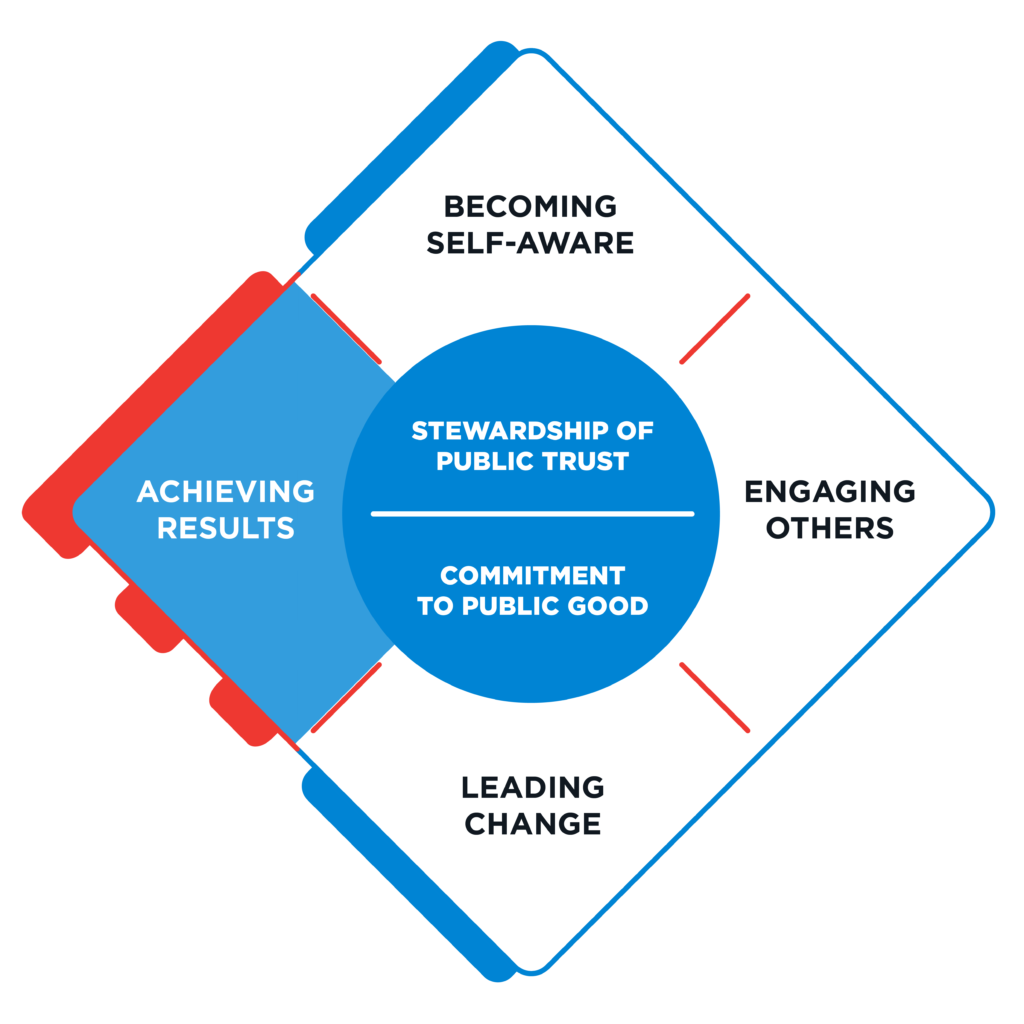
Accountability
Hold others accountable and accept responsibility for the consequences of your decisions.
“Accountability is the glue that ties commitment to the result.”
– Bob Proctor, international best-selling author, coach, and speaker
PUBLIC SERVICE LEADERSHIP IN ACTION
Responsibility is great, and has its place, but accountability is the “secret sauce” for leaders to set a culture for teams to build trust and rebound from mistakes and learning moments.
Learn how Phillip A. Brooks, Byron Bunker, and Josh H. Van Eaton conducted a steadfast investigation to hold Volkswagen accountable for rigging more than a half million vehicles to evade pollution regulations.
Charlie Bolden discusses how results need to be accompanied by metrics so that you can prescribe greater meaning to the changes being made.
REFLECTIVE QUESTIONS
- Why is accountability important in my work environment? What are the benefits?
- When something goes wrong in my purview of work, how likely am I to take responsibility? What gets in the way of taking ownership over my work?
- What do people fear about accountability? How could these fears be mitigated?
READ: 5 Ways to Promote Accountability – Andrew Robertson and Nate Dvorak, Consultants and researchers at Gallup
READ: 4 Ways to Improve Accountability in your Office – Jackson Nickerson, Associate Dean at Brookings Executive Education and GovExec contributer
READ: The Best Teams Hold Themselves Accountable – Joseph Grenny, Harvard Business Review
Evidence-based Decision-making
Make choices grounded in the best available information and data.
“Without data, you’re just another person with an opinion”
– W. Edwards Deming, renowned data scientist
PUBLIC SERVICE LEADERSHIP IN ACTION
Read how Arthur A. Allen used years of research to create the life-saving Search and Rescue Optimal Planning System (SAROPS).
REFLECTIVE QUESTIONS
- What are my trusted sources for facts, and how do I use these sources in my work?
- How do I know when I have “enough” information to make a decision?
- How can I best weigh facts and data with emotions and other considerations?
READ: A Leader’s Framework for Decision Making – David J. Snowden and Mary E. Boone, Harvard Business Review contributors
READ: Evidence, Facts and Intuition in Decision Making – IdeasforLeaders.com
READ: The Need for Analytics in Government Decision-making – Steve Bennett, SAS Global Government Practice and Federal Times contributor
Systems Thinking
Learn how to navigate the unique government system.
“Systems thinking is a discipline for seeing wholes. It’s a framework for seeing interrelationships rather than things, for seeing ‘patterns for change’ rather than static ‘snapshots’.”
– Peter Senge, systems scientists and lecturer at MIT
PUBLIC SERVICE LEADERSHIP IN ACTION
Hear Admiral Thad Allen talk about how leading in complex times requires co-production across boundaries, supported by continuous learning and emotional intelligence.
Learn about Jacob Moss’ efforts to build an alliance of federal and international agencies, countries and corporations to bring more efficient cook stoves and cleaner burning fuels to homes in developing nations, protecting the environment and the health of millions of people worldwide.
REFLECTIVE QUESTIONS
- If explaining my work environment to others, how would I describe it? What factors make it unique?
- Who are the key decision-makers, stakeholders and influencers within my organization?
- What are some ways that my colleagues and I can first learn, and then better navigate our work environment?
READ: Tackling Management Challenges at the Department of Homeland Security – Tom Fox, Former VP, Leadership Development at the Partnership for Public Service and contributor to Washington Post
READ: Implementing Cross-Agency Collaboration: A Guide for Federal Managers – Jane Fountain, Professor at University of Massachusetts and BusinessofGovernment.org contributor
READ: A User’s Guide to Getting Things Done in Government – Alexis Wichowski, Professor at Columbia University’s School of International and Public Affairs and GovExec.com contributor
Technology Acumen
Understand the importance of technology and how it can improve organizational outcomes.
“Information technology and business are becoming inextricably interwoven. I don’t think anyone can talk meaningfully about one without talking about the other.”
– Bill Gates, founder of Microsoft and renowned philanthropist
PUBLIC SERVICE LEADERSHIP IN ACTION
REFLECTIVE QUESTIONS
- In what areas of technology am I strong? How might I offer assistance to others?
- In what areas of technology am I weak? How might I bridge that gap or learn what I need to know?
- How might I stay up-to-date on the latest trends and tools?
READ: A Tech-Savvy Government – Roxy Torrer, Former ATD Staff and author
READ: Government Needs Tech-Savvy Leaders to Succeed, Says Outgoing OMB Chief – Kellie Lunney, Senior Correspondent at GovExec.com
READ: 5 Ways You Can Instantly Become More Tech Savvy – Drew Hendricks, Marketing Manager at Nextiva and BusinessCollective.com contributor
Customer Experience
Act with internal and external customers in mind.
“How you think about your customer influences how you respond to them.”
– Marilyn Suttle, Customer Service author and speaker
PUBLIC SERVICE LEADERSHIP IN ACTION
Learn how Paul McGann, Jean D. Moody-Williams, and Dennis Wagner created an innovative public-private sector initiative at the Centers for Medicare and Medicaid Services to increase patient safety and reduce readmissions to U.S. hospitals – in part by incorporating the views of the patients and families into the initiative.
REFLECTIVE QUESTIONS
- What do my customers care most about?
- How well is my organization currently meeting customer needs and wants? What else might we be doing?
- How will excellent customer service lead to greater ability to meet our mission?
READ: Improving the Customer Experience to Achieve Government-Agency Goals – Tony D’Emidio, David Malfara, and Kevin Neher, McKinsey & Company
READ: Defining Your Role in Government Customer Service – GovLoop
WATCH: How Airbnb Designs for Trust – Joe Gebbia, Co-founder of Airbnb and Ted Talk Speaker
© 2025 Partnership for Public Service, Inc. All rights reserved.