


Executive Summary
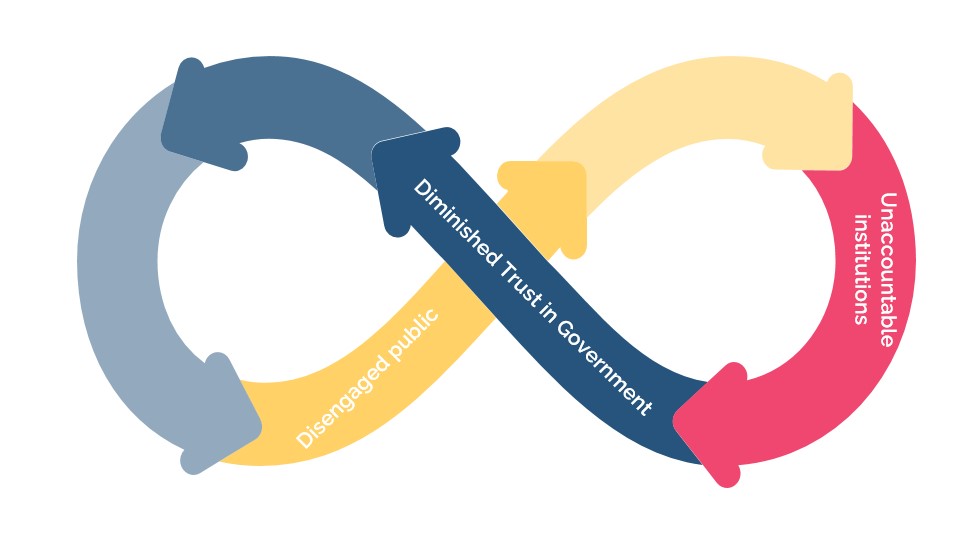
America is experiencing a lack of trust in major institutions—particularly the federal government. Only 4 in 10 Americans say they trust the federal government to do what is right at least some of the time, according to a national survey conducted by the Partnership for Public Service and Freedman Consulting.
This lack of trust has serious implications for how the public interacts with our government and how well federal agencies can respond to the major challenges facing the country. Today, the nation is experiencing serious repercussions because of this trust deficit. The COVID-19 pandemic has placed demands on federal agencies to provide services, public health information, vaccines or economic relief to nearly every household in America. In recent weeks, global events have also driven our government to embark on consequential foreign policy actions in service to our safety and security as well the health of democracies abroad. The highly polarized reaction to these efforts has brought trust to the forefront of the political debate.
The national survey seeks to understand how people in the United States feel about their federal government beyond the politics of the day and the leaders in Washington, D.C. It instead focuses on the parts of government that are often out of the political limelight: federal agencies and the 2 million civil servants who work across the country. It also investigates why people do or do not trust the government. This effort is the first in a series of publications the Partnership will publish in the coming months on trust in the federal government.
While several surveys have measured levels of trust over time, they rarely provide insight into the drivers of trust and the specific sources for changing expectations of government. The current challenges facing the country require more than simply knowing that trust is on the decline. This report helps to answer how people feel about the government at this moment in time and why they feel that way.
A majority of the public is distrustful of the federal government as a whole. More people feel the federal government has a negative impact (53%) on the United States than a positive one (38%). More than half do not believe the government helps people like them, and two-thirds believe the government is not transparent or does not listen to the public. For many members of the public, key associations with the federal government are politics and politicians—which are perceived very negatively. Members of Congress, for example, are seen favorably by only 30% of the public compared with 61% who see them unfavorably.
However, when asked about specific parts of the federal government, the public supports a number of key components. For example, people have mostly positive feelings when discussing certain federal agencies, missions or services that have direct contact with people. Many well-known government agencies are seen favorably. Majorities of the public see government employees favorably. And more people say their personal experiences with the government have been positive rather than negative.
Among the major findings of the survey:
- Only 40% of respondents said they trust the federal government a lot or somewhat, and 56% did not trust the government much or at all.
- Just 38% said the federal government has a positive impact on the United States, while 53% said the impact was negative.
- A third of respondents (33%) believe that the federal government treats people fairly regardless of race, class, gender, level of ability or any other demographic characteristic.
- Many variations in views are explained by partisan differences. Democrats are far more likely to trust the government (60%) than Republicans (27%) and independents (26%).
- Blacks (at 51%) and Asian Americans or Pacific Islanders (50%) are more likely to trust the government than Hispanics (39%) and Whites (38%).
- More people said their personal experiences with the federal government had been positive (48%) than not (38%).
- Views of federal employees are complex but mostly positive. A majority of respondents (57%) said federal employees are doing public service, and 56% said they are hard workers. Half thought that federal workers are committed to helping “people like me” compared with 33% who say they are not.
- A majority (57%) said that “serving their communities” is very important to why federal workers take their jobs, and 47% said public service is a leading motivating factor. Still, more people said that federal employees work for benefits, job security and salary than for other reasons.
- The public values the role an effective federal government plays in strengthening democracy and protecting our country. Two messages supporting these missions tested slightly better than others regarding what makes the public think more favorably about government.
The public’s distrust of Washington and political institutions is a well-documented and longstanding problem. By diving deeper and seeing its potential causes, we can develop a better understanding of trust to strengthen the public’s relationship with the federal government, particularly those elements not subject to electoral politics. This research presents several bright spots and opportunities to improve perceptions of government by better telling its story and impact. Finally, the findings suggest several potential options for reform to increase the trustworthiness of federal institutions.